Open editor
Open source · No install · No sign-up

FigCraft, online

A free interface design tool with Figma’s layout, running in a browser tab. Build screens with frames and auto layout, make components and variants, wire up a prototype and inspect the code. Nothing to install and no account to create.

FigCraft web build v0.5.1 · released Oct 12, 2026 · about 6 MB to download, then opens from cache

FigCraft app iconRuns the open-source FigCraft by the ArtCraft team · source on GitHub
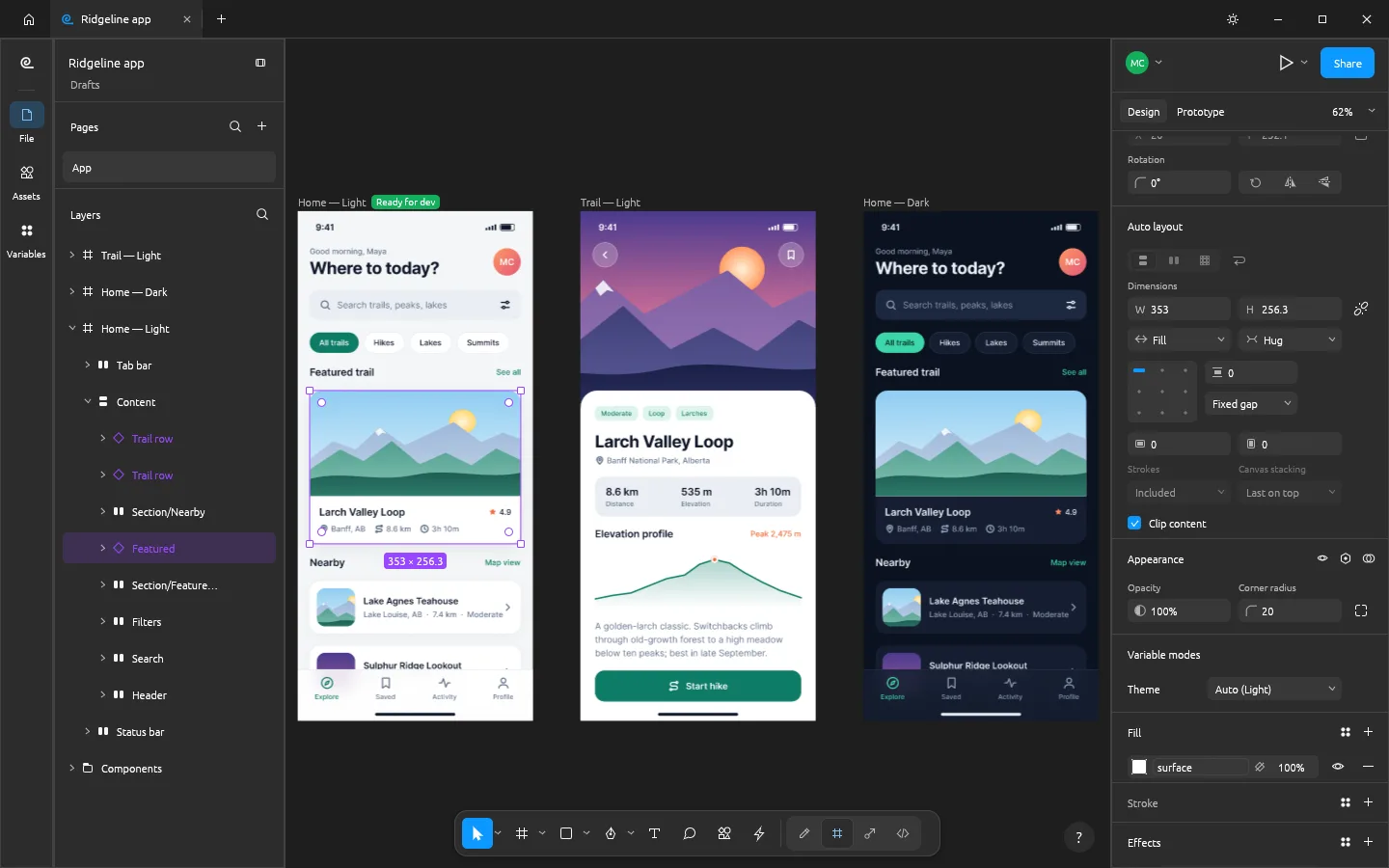
FigCraft editing a hiking app: three phone screens on the canvas, a trail card instance selected, the auto layout tree in the Layers panel and its sizing and colour variables in the Design panel
Ridgeline, an example app built in FigCraft: auto layout screens from components, with Light and Dark modes. Screenshot from the FigCraft project.
Auto layoutStacks, wrap and grids with Hug and Fill
ComponentsVariants, properties, styles and variables
PrototypesConnections, transitions and conditions
Private by designYour design never leaves the tab
In the editor

If you know Figma, you already know where things are

The toolbar, Layers panel, Design and Prototype tabs, menus and shortcuts sit where your hands expect them. Here is some of what FigCraft does. Screenshots from the FigCraft project.

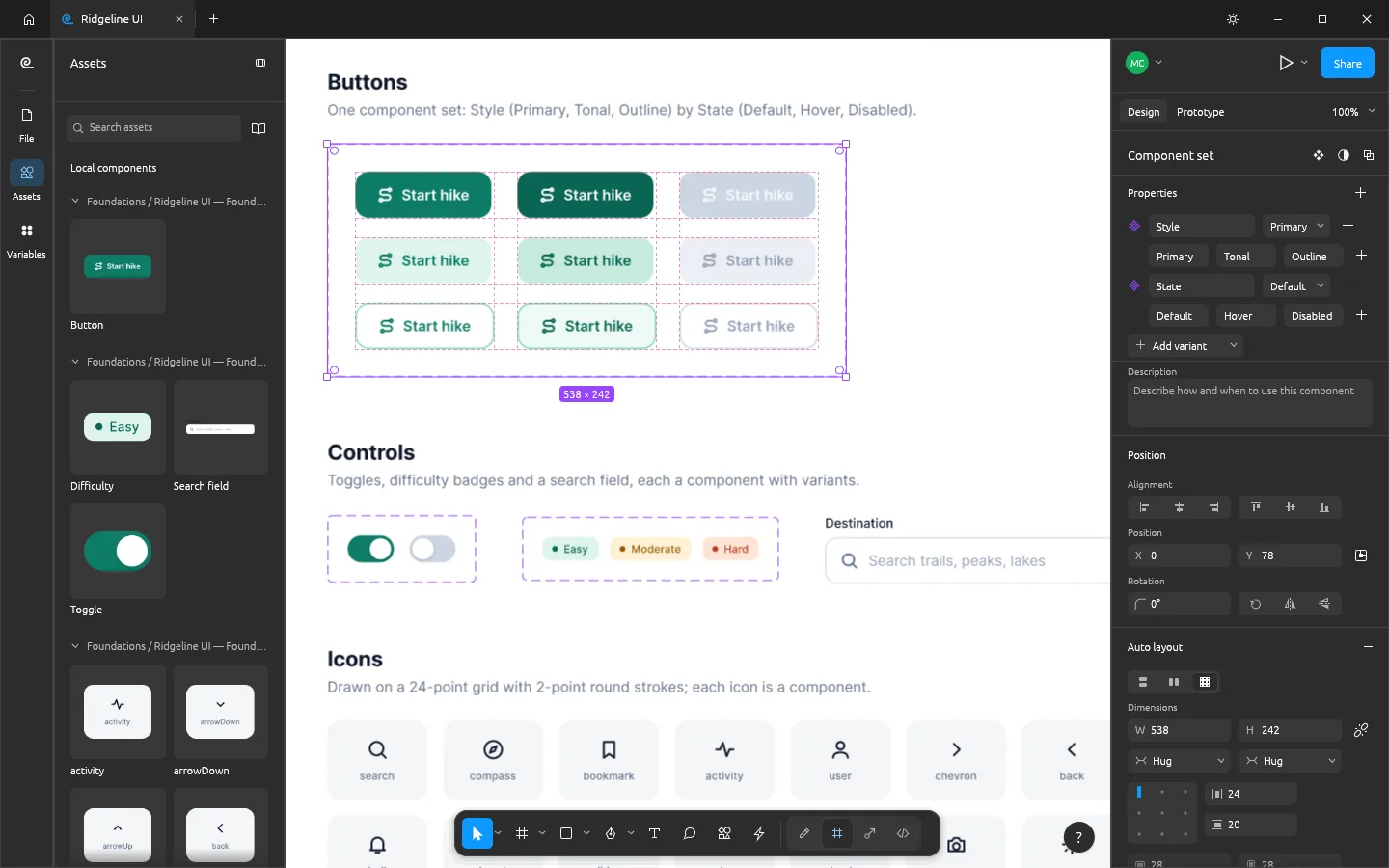
The Ridgeline design system with the Assets panel showing Button, Search field, Toggle and icon components, and a Button component set of nine variants selected with its Style and State properties in the Design panel

Components, variants and an Assets panel

Make a main component, drop instances and override them, and group variants into component sets with properties. Swap, detach and reset like you would in Figma. Styles and variables (colour, number, string, boolean) with modes bind to fills, strokes and effects.

A button component set with Style and State variants
FigCraft in its dark theme with three phone screens of a hiking app on the canvas, a trail card instance selected, the auto layout tree in the Layers panel and Fill and Hug sizing in the Design panel

Auto layout that builds the screen for you

Stack in either direction, wrap, or use a grid with fixed, hug and fr tracks. Padding, gaps, Hug / Fill / Fixed sizing and min and max sizes work as you expect, and one set of colour variables gives you Light and Dark modes.

Ridgeline, an example app from the FigCraft project
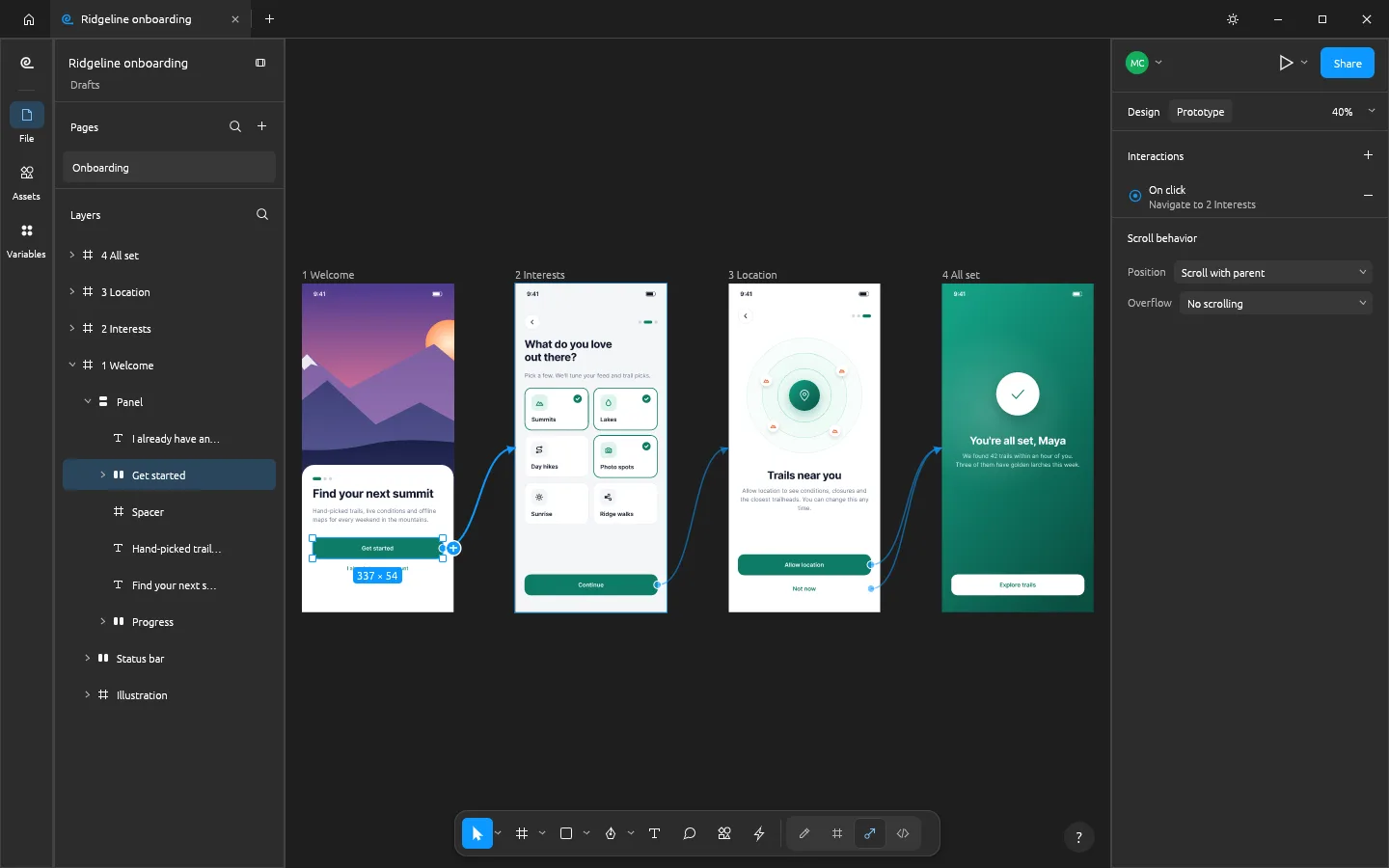
Four onboarding phone screens in the Prototype tab joined by connection curves, with the Get started button selected and its On click, Navigate to interaction in the Prototype panel

Click-through prototypes

Connect frames with triggers and actions, add Smart Animate-style transitions and flows, and set variables with if / else conditions. Present it with a device frame and click through it right in the tab.

An onboarding flow with its connections showing
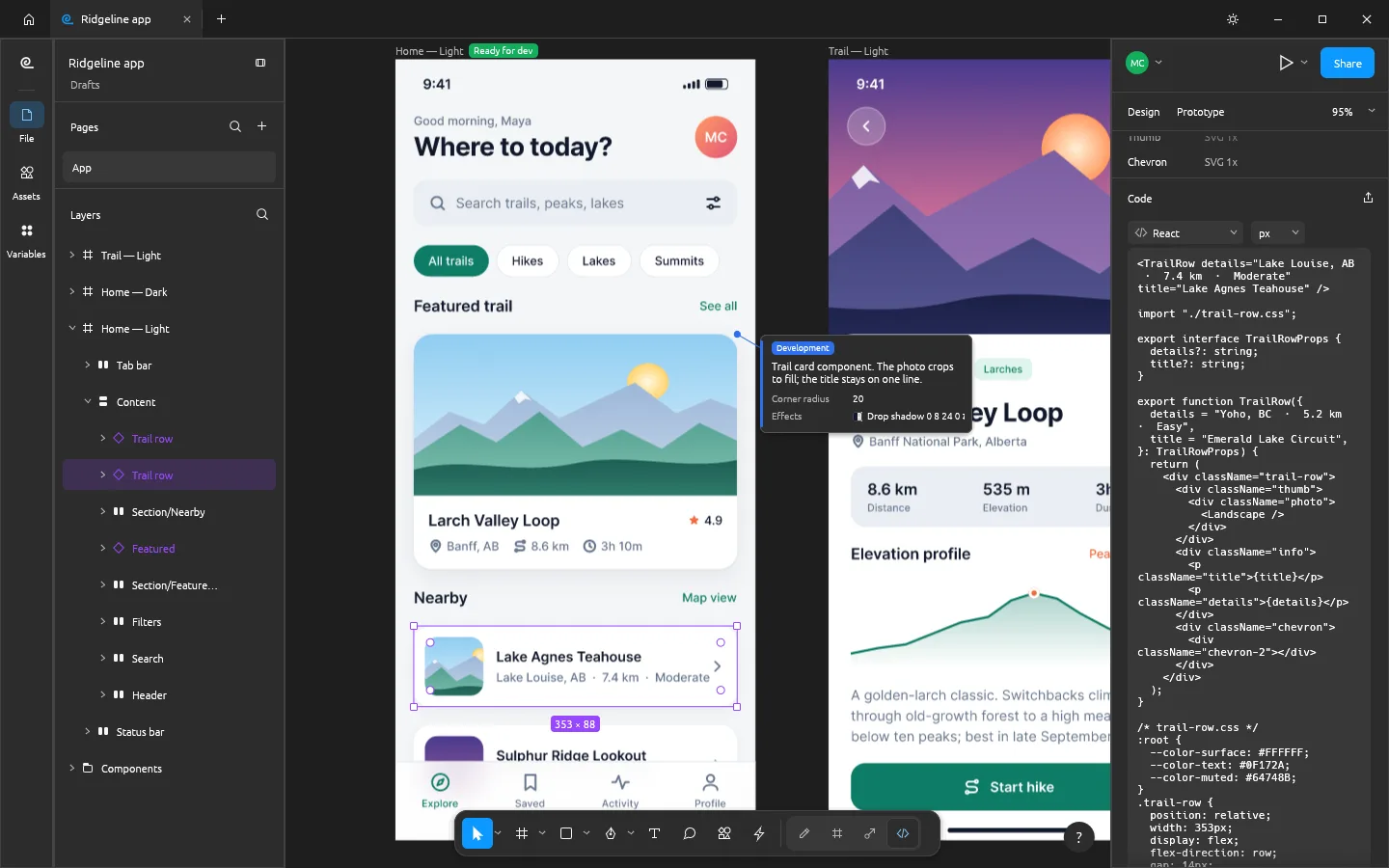
Dev Mode on a phone screen with a Ready for dev badge, an annotation callout on a card, and generated React code with a props interface in the Inspect panel

Inspect and code for handoff

Measure distances with Alt, mark frames ready for dev, annotate, and read generated CSS, HTML, React, SwiftUI or Compose code where component properties become parameters.

Dev Mode with React code for a list row
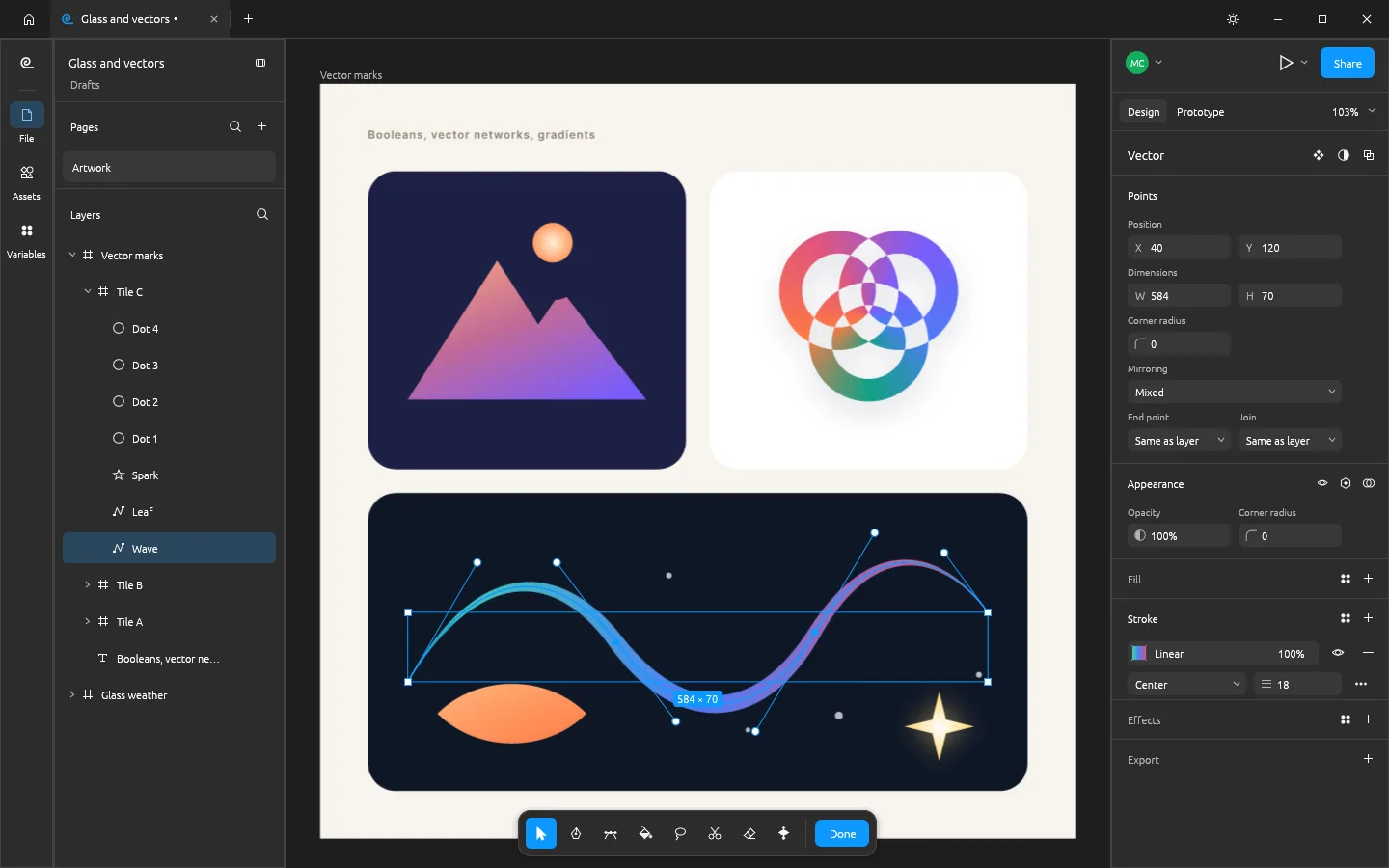
Vector edit mode on a wave path with a gradient and tapered variable-width stroke, its anchor points and handles visible, above a mountain mark built from booleans

Vector networks and booleans that stay editable

The Pen and Pencil draw real vector networks. Boolean groups keep every operand editable, the shape builder merges regions with a drag, and strokes can taper with variable width.

Vector edit mode on a variable-width stroke
AI tools · your own key or credits

Describe a screen, get editable layers

Open the AI panel next to the canvas, paste an OpenAI, Google Gemini or OpenRouter key (or sign in to use Craft Apps credits) and describe a mobile screen, a web page, a dashboard or a component. The model designs it, and one click adds it to the canvas as a frame with named layers and real text you can edit.

With your own key, requests go from your browser to the provider. We never see your key, prompts or designs, and we add no markup. No key? Pay per use with Craft Apps credits; new accounts get 30 free credits.

How the AI tools work
  • Text to UIMobile screens, web pages, dashboards, components and wireframes
  • Revise a designTell the model what to change and add the new version
  • Images for your designPhotos, illustrations, icons and backgrounds as image fills
This site

What figcraft.run adds

The editor is the official build, byte for byte. Around it we add a few things the bare build doesn’t have.

Import SVG and pictures

The browser build can’t open files yet. Our Import SVG or image button (or a drag onto the canvas) brings in an SVG as editable layers and a PNG, JPG, WebP or GIF as an image fill.

An AI panel on your own key or credits

FigCraft itself has no generative AI. The panel designs screens and makes images with OpenAI, Gemini or OpenRouter, straight from your browser, or with Craft Apps credits if you have no key.

Always the latest release

Each new FigCraft release is checked against its published SHA-256 checksum and deployed here. You are on v0.5.1.

Guides for common jobs

Plain answers on using FigCraft as a free Figma alternative and opening a .fig file without Figma.

Getting started

Three steps

  1. Open the editor. The first visit downloads the app, about 6 MB compressed. After that it opens from your browser’s cache. It starts with one empty file.
  2. Design. Press F for a frame (pick a phone or desktop size in the Design panel), R for a rectangle and T for text, then Shift+A to add auto layout. Bring in an SVG or a picture with Import SVG or image in the top bar, or ask the AI panel for a first draft.
  3. Present or hand off. Wire frames together in the Prototype tab and press the play button to click through them. To keep the file, rebuild or continue it in the free desktop app: the browser build can’t save yet.

FigCraft is in alpha and the browser build is a preview: it has no Save, no Export and no file opening yet. Use it to try FigCraft, sketch screens, test a prototype or join a live session; use the desktop app for work you want to keep.

FAQ

Questions

Is FigCraft Online free?

Yes. FigCraft is free and open source, and the editor needs no account. The optional AI tools are free with your own API key (your provider bills you for usage), or you can pay per use with Craft Apps credits, which need a free account.

Is FigCraft the same as Figma?

No. FigCraft is an independent, open-source design tool by the ArtCraft team that follows Figma’s layout, panels and shortcuts, so it feels familiar. It is in alpha: its developers estimate it is about half of the way to replacing Figma for real work. It isn’t made by or connected with Figma, Inc.

Can I save my work in the browser?

Not yet. The browser build of FigCraft 0.5 can’t save or export files, so your work lasts until you close the tab. To keep designs, use the free desktop app for Windows, macOS or Linux, which saves .figcraft files and exports PNG, JPG, WebP, SVG and PDF. Designs from our AI panel can be saved as SVG from the panel.

Can it open .fig files?

The desktop app opens .fig files on a best-effort basis, along with designs exported as Figma REST API JSON. The browser build can’t open files yet; on this site you can bring in SVG files (as editable layers) and PNG, JPG, WebP or GIF pictures with Import SVG or image.

Are my files uploaded anywhere?

No. FigCraft runs inside your browser with WebAssembly, and what you import stays in the tab. The only exception is the AI panel, which sends your prompt straight to the AI provider whose key you entered, or, with credits, to our Craft Apps service, which keeps nothing after it answers.

Can I collaborate with other people?

In preview. Someone using the FigCraft desktop app can share a file (Share › Start sharing) and give you the join code; you can join from this browser build and edit together, with live cursors and selections. The browser can join a session but can’t host one.

Which browsers work?

A current Chrome, Edge, Firefox or Safari with WebGPU or WebGL2. FigCraft uses WebGPU when it is available and falls back to WebGL2 on its own. A laptop or desktop with a mouse works best; FigCraft isn’t designed for touch.
Start a screen in your browser

Free, private, and already loaded on your next visit.

Open the editor